
Sports Betting Guide for Beginners: Odds, Bet Types, Rules, and Safer Wagering
Sports betting has its own language. Someone says they “hit a four-leg parlay at plus money,” and it can sound like everyone else got a handbook you missed. The good news is that the basics are not complicated once they are explained clearly.
This guide is written for Canadian beginners who want to understand how sports betting works before risking real money. It covers odds, payouts, implied probability, common bet types, settlement rules, bankroll management, beginner mistakes, and safer betting habits.
The goal is not to make betting sound easier than it is. Sportsbooks are built with a margin, and most recreational bettors lose over time. If you choose to bet, treat it as paid entertainment, not income.
For a review of the Parimatch sportsbook interface, odds formats, bet slip, and account tools, see our sportsbook review. For sport-by-sport market coverage, see the sports betting markets page.
Important: Parimatch operates as an offshore sportsbook under Curaçao licence OGL/2024/402/0624. Availability depends on the player’s province or territory and local rules. This page is informational only and does not provide legal or financial advice.
Quick Summary
| Topic | Beginner Takeaway |
|---|---|
| Odds | Show both payout and implied probability |
| Best starting bet | Singles on sports and markets you understand |
| Risky beginner habit | Chasing losses or relying heavily on parlays |
| Bankroll rule | Bet only money set aside for entertainment |
| Unit sizing | Many cautious beginners use 1–2% of bankroll per bet |
| Key skill | Understanding probability, rules, and discipline |
| Main warning | No strategy can guarantee profit |

Sports betting probability playbook and data analytics indicators.
A beginner does not need to know every market on day one. It is better to understand a few simple bets properly than to place complicated wagers because the payout looks exciting.
What Sports Betting Actually Means
Sports betting is placing money on an outcome connected to a sports event. That outcome could be simple, such as which team wins, or more specific, such as how many goals are scored, how many points a player records, or who wins the first period.
The sportsbook sets odds for each outcome. Those odds determine how much you can win and what probability the bookmaker is implying.
The important part: odds are not neutral. Sportsbooks build in a margin, sometimes called vig or juice. That means the sportsbook expects to make money over time, even if some users win individual bets.
How Betting Odds Work
Odds show two things at once:
- the potential payout;
- the implied probability of the outcome.
For example, decimal odds of 2.00 mean that a $10 bet would return $20 in total if it wins. That includes the original $10 stake plus $10 profit.
Decimal odds of 1.50 mean a $10 bet would return $15 in total. The payout is smaller because the outcome is considered more likely.
| Decimal Odds | $10 Stake Total Return | Profit | Approx. Implied Probability |
|---|---|---|---|
| 1.50 | $15.00 | $5.00 | 66.7% |
| 1.80 | $18.00 | $8.00 | 55.6% |
| 2.00 | $20.00 | $10.00 | 50.0% |
| 2.50 | $25.00 | $15.00 | 40.0% |
| 3.00 | $30.00 | $20.00 | 33.3% |
| 5.00 | $50.00 | $40.00 | 20.0% |
Higher odds do not mean a “better” bet by default. They usually mean the outcome is less likely.
Decimal, American, and Fractional Odds
Sportsbooks may allow users to choose different odds formats. The format changes how the number is displayed, but not the underlying bet.
| Odds Format | Example | What It Means |
|---|---|---|
| Decimal | 2.50 | Total return per $1 staked |
| American positive | +150 | Profit on a $100 stake |
| American negative | -200 | Stake needed to profit $100 |
| Fractional | 3/2 | Profit relative to stake |
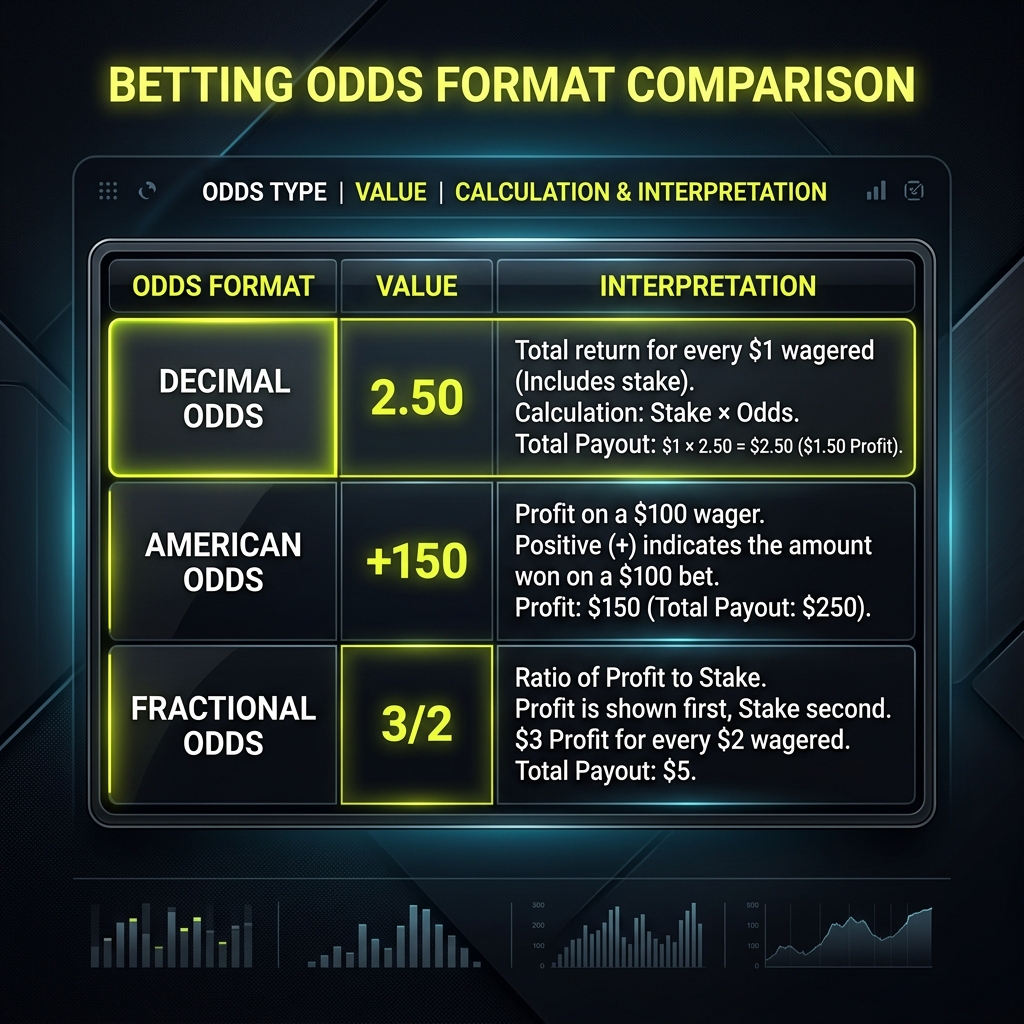
Odds format comparison panel showing payout translations.
Quick Examples:
Decimal odds:
- 2.50 means a $10 bet returns $25 total;
- 1.50 means a $10 bet returns $15 total.
American odds:
- +150 means a $100 bet profits $150;
- -200 means you must bet $200 to profit $100.
Fractional odds:
- 3/2 means a $2 bet profits $3;
- 1/2 means a $2 bet profits $1.
Parimatch may allow users to adjust odds format in account or sportsbook settings. For more on the platform itself, see our sportsbook review.
How to Calculate Implied Probability
Implied probability converts odds into an estimated chance of the outcome.
The formula for decimal odds is:
| Decimal Odds | Calculation | Implied Probability |
|---|---|---|
| 1.50 | 1 ÷ 1.50 × 100 | 66.7% |
| 2.00 | 1 ÷ 2.00 × 100 | 50.0% |
| 2.50 | 1 ÷ 2.50 × 100 | 40.0% |
| 3.00 | 1 ÷ 3.00 × 100 | 33.3% |
| 4.00 | 1 ÷ 4.00 × 100 | 25.0% |
This does not mean the sportsbook “knows” the exact chance. It means the odds are priced as if the chance is around that number, before adjusting for margin.
How to Calculate Payouts
For decimal odds, payout is simple:
Profit is the total return minus your original stake.
| Stake | Odds | Total Return | Profit |
|---|---|---|---|
| $10 | 1.80 | $18.00 | $8.00 |
| $25 | 1.91 | $47.75 | $22.75 |
| $50 | 2.20 | $110.00 | $60.00 |
| $100 | 1.50 | $150.00 | $50.00 |
Always separate return from profit. Many beginners see “returns $100” and forget that part of that amount is their original stake.
What Is the Bookmaker Margin?
The bookmaker margin is the built-in edge the sportsbook adds to the market. It is also called vig, juice, or overround.
Imagine a fair coin flip. True fair odds would be 2.00 on heads and 2.00 on tails. Each side has a 50% implied probability, so the total is 100%.
A sportsbook might instead offer 1.91 on both sides.
| Outcome | Odds | Implied Probability |
|---|---|---|
| Heads | 1.91 | 52.4% |
| Tails | 1.91 | 52.4% |
| Total | — | 104.8% |
The extra 4.8% is the sportsbook margin. This is why a bettor can pick winners at a decent rate and still lose money if the prices are poor.
Margins are usually lower on major sports and high-volume leagues, and higher on smaller events or niche markets. That is one reason odds comparison matters.
Common Types of Sports Bets
Most sports betting markets are built from a few basic bet types. Once you understand these, the sportsbook becomes much easier to read.
| Bet Type | What It Means | Beginner Difficulty |
|---|---|---|
| Single | One selection | Low |
| Parlay / accumulator | Multiple selections combined | Medium to high |
| Spread / handicap | Points or goals adjustment | Medium |
| Total | Over or under a number | Low to medium |
| Prop | Player or event-specific bet | Medium |
| Future | Long-term outcome | Medium |
| Live bet | Bet during the event | Medium to high |
| System bet | Multiple combinations from several picks | High |
Beginners are usually better off starting with singles and totals before moving into parlays, live bets, or complicated props.
Singles
A single is one bet on one outcome. If it wins, you win. If it loses, you lose the stake.
Example:
- NHL moneyline: Vancouver to win at 1.85
- Stake: $20
- Total return if it wins: $37
- Profit: $17
Singles are not “boring.” They are the cleanest way to learn whether your betting decisions are good because one result decides the wager.
Parlays and Accumulators
A parlay, also called an accumulator, combines multiple selections into one bet. Every selection usually needs to win for the parlay to pay out.
Example Parlay Slip:
| Leg | Selection | Odds |
|---|---|---|
| 1 | Team A to win | 1.80 |
| 2 | Team B to win | 1.80 |
| 3 | Over 5.5 goals | 1.80 |
| 4 | Team C +1.5 | 1.80 |
Combined Odds: 1.80 × 1.80 × 1.80 × 1.80 = 10.50
A $10 bet would return about $105 if all four legs win. That looks exciting, but the risk is much higher than a single. One losing leg usually loses the entire parlay.
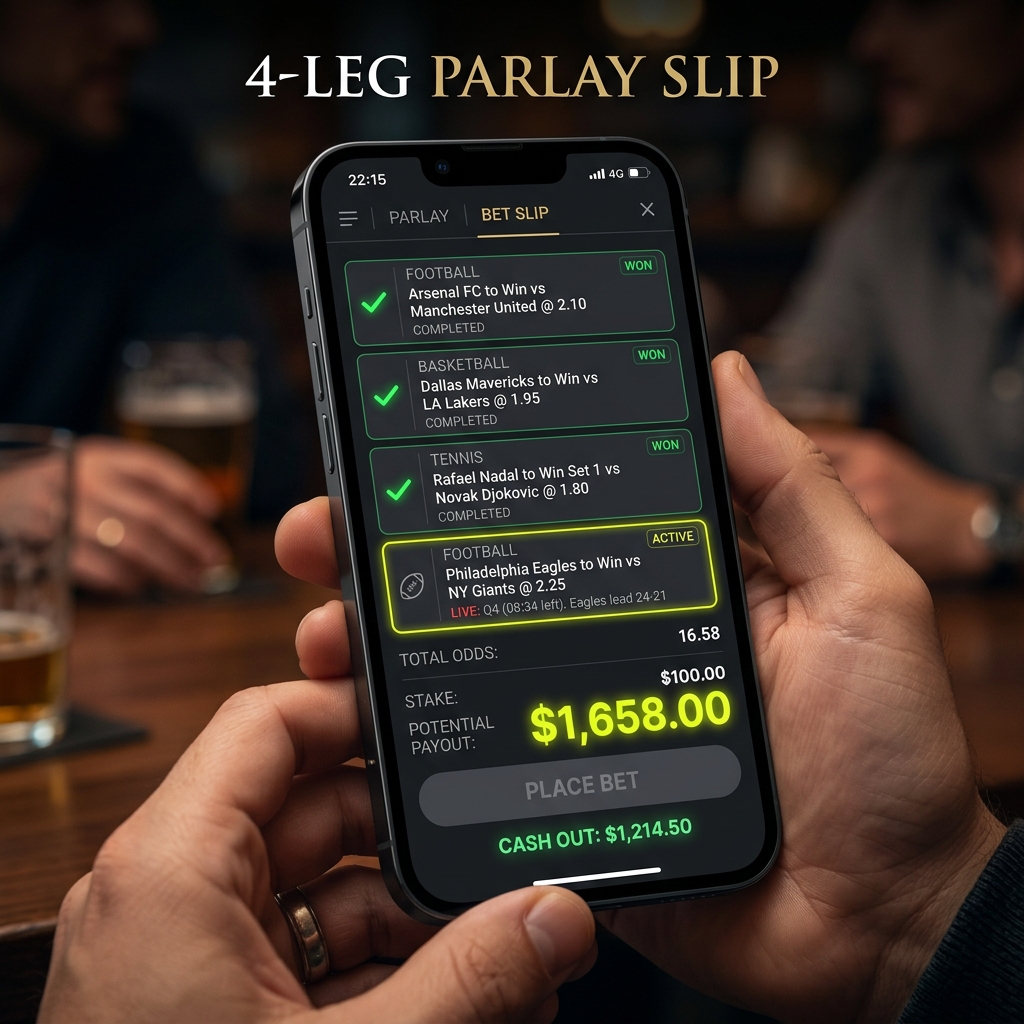
A multi-leg parlay ticket detail showing leg statuses and payouts.
| Parlay Size | Main Appeal | Main Risk |
|---|---|---|
| 2 legs | Higher payout than a single | Both picks must win |
| 3–4 legs | Bigger return | One miss ruins the ticket |
| 5+ legs | Large potential payout | Very low hit rate |
| Same-game parlay | Fun to follow | Correlation and pricing can be complex |
Parlays can be entertainment, but they should not be treated as a reliable strategy.
System Bets
System bets create multiple smaller combinations from a group of selections. They are more flexible than a regular parlay because not every pick must win, depending on the system.
For example, a “2 of 3” system bet creates three doubles from three selections. If one selection loses, one or more combinations may still win.
| System Type | How It Works | Who It Suits |
|---|---|---|
| 2 of 3 | Creates all possible doubles from 3 picks | Users who want some protection |
| 3 of 4 | Creates all possible trebles from 4 picks | More advanced bettors |
| Full cover | Multiple combinations included | Experienced users only |
System bets can be confusing for beginners because stake distribution and payout calculations are less obvious. If you do not understand how the bet settles, skip it.
Spreads and Handicaps
A spread or handicap gives one team a virtual advantage or disadvantage before the event starts.
In hockey, this is often called the puck line. In football and basketball, it is usually called the spread. In soccer, it may appear as a handicap.
Example:
- Toronto -1.5 means Toronto must win by 2 or more.
- Ottawa +1.5 means Ottawa can win or lose by 1 and the bet still wins.
| Handicap Bet | What Must Happen |
|---|---|
| Favourite -1.5 | Favourite must win by 2+ |
| Underdog +1.5 | Underdog can win or lose by 1 |
| Favourite -3.5 | Favourite must win by 4+ |
| Underdog +7.5 | Underdog can lose by 7 or fewer |
Handicaps are useful when the simple winner price is too short or when you expect a close game.
Asian Handicaps
Asian handicaps are more common in soccer but may appear in other sports. They remove or reduce the chance of a draw by using half or quarter lines.
| Asian Handicap | Meaning |
|---|---|
| -0.5 | Team must win |
| 0.0 | Draw returns stake |
| +0.5 | Team wins or draws |
| -0.75 | Stake split between -0.5 and -1.0 |
| +0.25 | Stake split between 0.0 and +0.5 |
Quarter-line handicaps can result in half-win or half-loss outcomes. They are useful but should be understood before betting.
Totals: Over and Under
Totals betting means betting on whether the combined score will be over or under a number.
Example:
- NHL total: 6.5 goals
- Over 6.5 wins if there are 7 or more goals
- Under 6.5 wins if there are 6 or fewer goals
| Sport | Common Total Example |
|---|---|
| Hockey | Over/under total goals |
| Basketball | Over/under total points |
| Football | Over/under total points |
| Soccer | Over/under goals |
| Baseball | Over/under runs |
| Tennis | Over/under games |
Totals can be beginner-friendly because you do not need to pick the winner. But you still need to understand pace, matchup, injuries, and market rules.
Asian Totals
Asian totals work like Asian handicaps but apply to the total score.
Example: Over 5.25 goals splits the stake between Over 5.0 and Over 5.5. If exactly 5 goals are scored, the Over 5.0 part pushes, and the Over 5.5 part loses. That creates a half-loss.
| Asian Total | Possible Outcome |
|---|---|
| Over 5.0 | Exactly 5 pushes |
| Over 5.5 | Needs 6+ |
| Over 5.25 | Half stake on 5.0, half on 5.5 |
| Under 6.25 | Half stake on 6.0, half on 6.5 |
If the settlement feels unclear, choose a simpler total until you are comfortable.
Props, Futures, and Specials
Props are bets on specific things inside an event. Futures are long-term bets. Specials are event-based or one-off markets.
| Market Type | Example | Main Caution |
|---|---|---|
| Player prop | Player over 2.5 shots | Depends on role and minutes |
| Game prop | Goal in first 10 minutes | Can be volatile |
| Future | Stanley Cup winner | Funds tied up for a long time |
| Special | Tournament-specific market | Rules may vary |
Props can be useful if you follow a sport closely, but they can also tempt users into betting on details they do not really understand.
Live Betting
Live betting allows users to place bets while an event is already in progress. Odds update during the game based on score, time, injuries, penalties, momentum, and other factors.
| Live Betting Feature | What to Know |
|---|---|
| Odds change quickly | Prices may move before you confirm |
| Bet delay | A short acceptance delay may apply |
| Market suspension | Betting may pause after major events |
| Cash Out | Early settlement may be offered |
| Higher emotional risk | Speed can lead to poor decisions |
Live betting can be exciting, but beginners should use smaller stakes and avoid chasing. For a full guide, see our live betting guide.
Parimatch Betting Rules and Settlement
Before placing real-money bets, users should understand how settlement works. Settlement rules determine whether a bet wins, loses, pushes, or becomes void.
The exact rules may vary by sport and market, so users should check the current Parimatch terms before betting.
| Situation | Common Settlement Approach |
|---|---|
| Official result | Bets usually settle on the official final result |
| Postponed match | Bet may stand if replayed within the stated period |
| Cancelled match | Bet may be voided and stake returned |
| Player retirement | Sport-specific rules apply |
| Overtime | Some markets include it, others do not |
| Dead heat | Stake may be divided among tied selections |
| Palpable error | Clearly incorrect odds may be voided |
Do not assume every market follows the same rules. Hockey regulation-time bets, tennis retirements, and futures markets can all settle differently.
Voided and Postponed Matches
If an event is postponed, bets may stand if the event is rescheduled within the timeframe listed in the sportsbook rules. If not, bets may be voided and stakes returned. This is common across sportsbooks, but exact timeframes can vary.
Examples include:
- a football match postponed by weather;
- a tennis match suspended overnight;
- a baseball game delayed or cancelled;
- a hockey game moved to another date.
If the timing of a match changes, check the bet history and official rules rather than guessing.
Maximum Payouts and Stake Limits
Sportsbooks may apply maximum payout limits and stake limits. These can vary by sport, league, market, account, and risk profile. Major professional leagues usually have higher limits than niche sports or lower-tier competitions. Accumulators may also have maximum payout caps.
| Market Type | Typical Limit Pattern |
|---|---|
| Major leagues | Higher limits |
| Smaller leagues | Lower limits |
| Niche sports | Often lower limits |
| Props | May be lower than main markets |
| Futures | Can vary widely |
| Parlays | May have maximum payout caps |
If you are placing a large bet or high-odds parlay, check the limits first.
Dead Heat Rules
A dead heat happens when two or more participants tie for a finishing position in a market where placement matters. This is common in golf, racing, and some tournament markets.
Example:
- You bet on a golfer to finish top 5.
- Several players tie for the final top-5 spot.
- Your stake may be divided according to dead heat rules.
Dead heat settlement can reduce your payout even when the selection technically places. This is not an error; it is part of the market rules.
Palpable Error and Bet Cancellation
A palpable error is a clearly incorrect price or market caused by a technical or human mistake.
Examples:
- A heavy favourite is accidentally listed at 15.00 instead of 1.50.
- A market remains open after a goal has already happened.
- A data-feed error creates impossible odds.
In these situations, the sportsbook may void affected bets under its terms. This is standard across the betting industry, but users should still read the rules before placing wagers.
Bankroll Management
Bankroll management means deciding how much money you are willing to risk and how much you will stake on each bet. Your bankroll should be money set aside for entertainment. It should not include rent, groceries, bills, debt payments, savings, or emergency funds.
| Bankroll Size | 1% Unit | 2% Unit | 5% Unit |
|---|---|---|---|
| $100 | $1 | $2 | $5 |
| $250 | $2.50 | $5 | $12.50 |
| $500 | $5 | $10 | $25 |
| $1,000 | $10 | $20 | $50 |
For beginners, 1–2% per bet is usually more sensible than large stakes. A 5% unit can feel small until a losing streak happens.
Why Unit Sizing Matters
Even good picks lose. A bettor can make reasonable decisions and still lose several bets in a row. Unit sizing helps prevent a normal losing streak from becoming a financial problem.
Example:
- Bankroll: $200
- Unit size: 2%
- Bet size: $4
This gives you room to place many bets without risking everything quickly. If you bet $40 at a time from the same $200 bankroll, five losses would wipe you out. That is not strategy; it is gambling too aggressively.
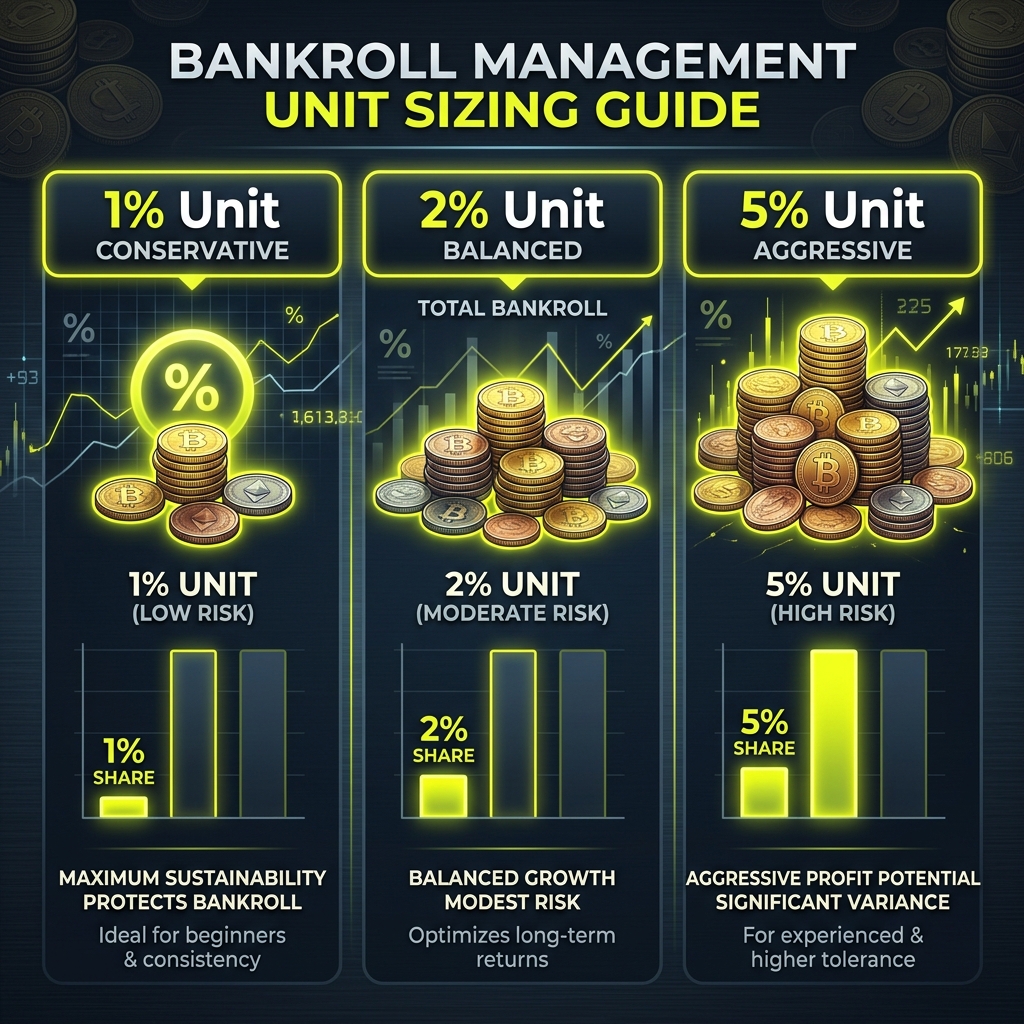
Bankroll unit allocation guide and risk segmentation chart.
Value Betting Basics
A value bet exists when you believe the true probability of an outcome is higher than the probability implied by the odds.
Example:
- Odds imply a team has a 45% chance.
- Your analysis suggests the team has a 55% chance.
- If your estimate is accurate, the bet may have value.
The difficult part is that most bettors overestimate their ability to judge probability. Value betting requires research, price comparison, record-keeping, and honesty. It is not the same as saying, “I feel like this team will win.”
Line Shopping
Line shopping means comparing odds across sportsbooks before betting. A small difference in odds can matter over time.
| Sportsbook A | Sportsbook B | Better Price |
|---|---|---|
| 1.85 | 1.91 | 1.91 |
| 2.05 | 2.10 | 2.10 |
| 1.50 | 1.55 | 1.55 |
| 3.00 | 3.15 | 3.15 |
If two sportsbooks offer different odds for the same outcome, the higher price gives a better potential return. Over hundreds of bets, this can make a meaningful difference.
Tracking Your Bets
Keeping records is one of the simplest ways to improve your betting habits. It also keeps you honest.
Track:
- date;
- sport;
- event;
- market;
- odds;
- stake;
- result;
- profit or loss;
- reason for the bet.
| Date | Sport | Market | Odds | Stake | Result | Profit/Loss |
|---|---|---|---|---|---|---|
| Jan 10 | NHL | Moneyline | 1.90 | $5 | Win | +$4.50 |
| Jan 11 | NBA | Total | 1.91 | $5 | Loss | -$5.00 |
| Jan 12 | Soccer | Draw no bet | 1.75 | $5 | Push | $0.00 |
After 50 or 100 bets, patterns become clearer. You may discover that you do well on singles but lose on parlays, or that live betting causes poor decisions.
Common Beginner Mistakes
Most beginner mistakes are predictable. Avoiding them will not guarantee profit, but it can reduce unnecessary losses.
| Mistake | Why It Is a Problem |
|---|---|
| Betting favourite teams | Emotion can distort judgment |
| Chasing losses | Turns one loss into a larger problem |
| Overusing parlays | High payouts hide low probability |
| Ignoring bankroll limits | Leads to oversized bets |
| Betting while angry or tired | Poor decisions become more likely |
| Not checking rules | Settlement surprises can happen |
| Following tips blindly | You do not know the reasoning |
| Betting every game | More action does not mean better value |
A useful rule: if you cannot explain why the bet makes sense, do not place it.
Beginner-Friendly Starting Plan
If you are new, keep the first stage simple.
A cautious beginner plan might look like this:
- choose one or two sports you already follow;
- start with singles only;
- use small stakes;
- avoid live betting at first;
- avoid parlays except occasional tiny stakes;
- track every bet;
- review results after 50 bets;
- use deposit limits from the start.
| Stage | Focus |
|---|---|
| First 10 bets | Learn bet slip, odds, settlement |
| First 25 bets | Understand results and emotions |
| First 50 bets | Review which markets you handle best |
| After 100 bets | Decide whether betting still feels controlled and affordable |
There is no need to rush. Betting slowly is usually better than learning expensive lessons quickly.
Bonuses and Beginner Bettors
Sportsbook bonuses can look attractive, but they come with terms. A bonus is not free money if it requires risky betting, high wagering, or short deadlines.
| Bonus Term | Why It Matters |
|---|---|
| Wagering requirement | Shows how much you must bet before withdrawing |
| Minimum odds | Some safer-looking bets may not qualify |
| Expiry date | Short deadlines can pressure bad decisions |
| Eligible markets | Some props or live bets may not count |
| Maximum winnings | Limits upside from bonus funds |
For a full breakdown, see the bonus page.
Payments and Verification
Before depositing, understand how payments and withdrawals work. This is especially important for offshore sportsbooks because payment availability and processing can vary.
| Payment Question | Why It Matters |
|---|---|
| Can I use CAD? | Helps avoid currency conversion costs |
| How fast are deposits? | Affects when funds are available |
| How do withdrawals work? | Important before you win |
| Is KYC required? | Verification can delay cashouts |
| Are there fees? | Fees reduce overall value |
| Are there limits? | Limits affect deposits and withdrawals |
For full details, see the payments page.
Responsible Betting
Sports betting should be entertainment. It should not be a way to pay bills, recover debt, or solve financial stress. Set limits before you bet, not after a losing streak. If you feel the urge to bet more because you are behind, pause immediately.
Warning signs include:
- betting more than planned;
- hiding betting from others;
- borrowing money to gamble;
- chasing losses;
- feeling anxious when not betting;
- needing bigger stakes for excitement;
- betting with money needed for essentials.
If betting stops feeling controlled, use limit tools, cooling-off options, or self-exclusion, and seek support.
Canadian support resources include:
- ConnexOntario: 1-866-531-2600
- Gambling Support BC: 1-888-795-6111
- Gamblers Anonymous Canada: www.gacanada.ca
- Canadian Centre on Substance Use and Addiction: www.ccsa.ca
FAQ
Q: I only want to bet $10. Is that enough to start?
A: Yes. A small bankroll can be enough to learn how odds, bet slips, and settlement work. Use very small stakes and do not add more money unless it remains affordable entertainment.
Q: What is the safest type of bet for beginners?
A: Singles on markets you understand are usually the simplest. For example, if you follow hockey, a moneyline or total may be easier to understand than a complex parlay or player prop.
Q: What is a parlay?
A: A parlay combines multiple selections into one bet. All legs usually need to win. Parlays offer higher potential payouts but lower chances of success.
Q: Why do sportsbooks have a margin?
A: The margin is the sportsbook’s built-in edge. It is how bookmakers make money over time, even when users win some individual bets.
Q: How do I know if odds are good?
A: Compare prices across sportsbooks and understand the implied probability. Higher odds on the same outcome are generally better, but the bet still needs to make sense.
Q: What happens if a game is postponed?
A: It depends on the sportsbook and sport-specific rules. The bet may stand if the event is rescheduled within the stated timeframe, or it may be voided and refunded.
Q: Can I make a living from sports betting?
A: For most people, no. A very small number of bettors are profitable long term, and they treat betting like a serious analytical job. Beginners should treat betting as entertainment only.
Q: What is bankroll management?
A: Bankroll management means setting aside a fixed amount for betting and using consistent stake sizes. It helps prevent emotional or oversized bets.
Q: How should I track my bets?
A: Use a spreadsheet or notes app. Record the date, sport, market, odds, stake, result, and profit or loss.
Q: Are betting bonuses good for beginners?
A: They can be useful, but only if the terms are clear and reasonable. Avoid bonuses that pressure you into betting more or faster than planned.
Q: Is live betting suitable for beginners?
A: It is usually better to learn pre-match betting first. Live betting moves quickly and can encourage emotional decisions.
Q: Is Parimatch provincially regulated in Canada?
A: No. Parimatch operates under Curaçao licence OGL/2024/402/0624 and is not provincially regulated in Canada.
REGULATORY DISCLOSURE: Parimatch operates under licence OGL/2024/402/0624 issued by the Curaçao Gaming Authority. Parimatch is not licensed by Canadian provincial regulators and is not available in jurisdictions where such operation is restricted, including Ontario, where online gambling operators must be licensed by the Alcohol and Gaming Commission of Ontario (AGCO) and registered with iGaming Ontario. Players are responsible for verifying the legality of online gambling in their province or territory before registering. This website provides information only and does not constitute legal advice.